
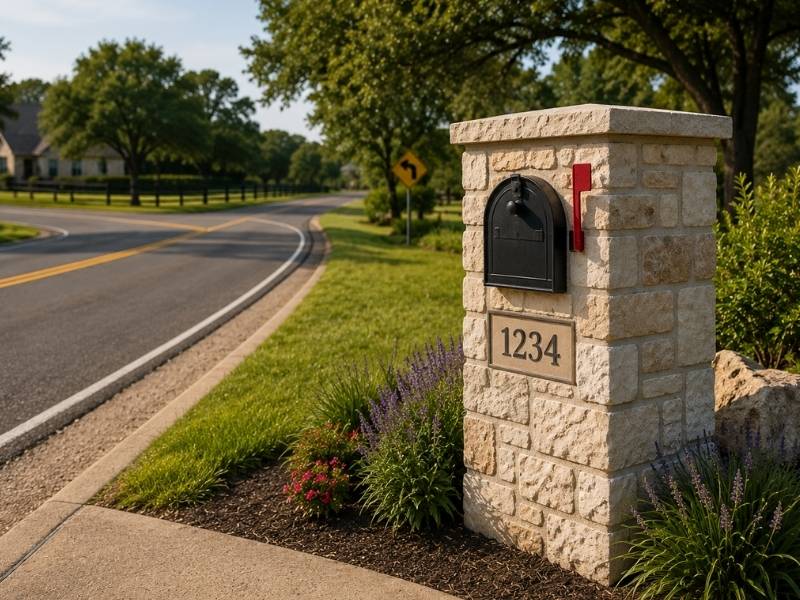
A stone mailbox weighs a few hundred pounds and doesn’t move when a car hits it. That’s the whole design problem in one sentence. Wood posts snap and steel pipes bend, but masonry stays put and the vehicle absorbs everything. Place it wrong and you’ve built a hazard at the edge of a public road with your name on the deed.
Choosing a safe location along the road
Start with what a driver can see and where a car ends up when things go wrong. Roadside safety guidance treats heavy fixed objects near travel lanes as hazards, and a stone structure fits that description. The closer it sits to the pavement and the faster the road, the worse the math gets.
Curves are the worst spot. Cars that leave the road do it on the outside of a bend, and that’s exactly where people love to put a nice stone mailbox. Straight sections with room behind them are the safer choice, and the extra few feet of setback matters more than any design detail.
Sight lines come next. Your mailbox shouldn’t block a driver’s view of an intersection, a crosswalk or a neighbor’s driveway. Stand where an approaching car would be and look. If the structure hides anything a driver needs to see, move it.
Meeting USPS and local placement requirements
USPS sets the basic numbers. The standard is 41 to 45 inches from the road surface to the bottom of the mailbox, and 6 to 8 inches back from the front face of the curb or road edge to the door of the box. Confirm the current standard before you build, because these get referenced wrong constantly.
The local postmaster has the final say on placement. That’s the part most people skip, and it’s a free phone call. Ask before you pour anything.
Local rules stack on top of the USPS numbers. Many cities and states restrict or ban masonry mailbox supports in the public right-of-way, and some allow them only with a specific breakaway detail. HOA rules add another layer, and they’re often stricter than the city. Check all three before design, because they don’t always agree.
The right-of-way surprise
That strip of grass between the sidewalk and the street usually isn’t yours. It’s public right-of-way, and you’re building on it with permission you may not have asked for. The city can require removal at your cost.
Some agencies issue an encroachment permit for structures in that zone. Others say no to masonry outright. Find out which one you’re dealing with before the stone shows up on a pallet.
Planning a stable foundation for a stone mailbox
Weight is the reason this needs a real footing. A stone mailbox concentrates a heavy load on a small patch of soil at the edge of a road, and that soil is often fill from when the road was built. Fill settles, and a settled corner shows up as a lean.
Soil moisture drives most of the movement. Clay soils swell when wet and shrink when dry, which lifts and drops whatever sits on them. Roadside soil also gets the runoff from the whole street, so it swings harder than the soil in your yard does.
Pick the location with drainage in mind. Avoid the low spot where water collects and stay out of the ditch line. In climates that freeze, the footing needs to reach below the local frost depth, and the building department will tell you that number.
Compaction under the footing matters as much as the concrete above it. A footing on loose fill leans no matter how much rebar it has. Have someone check the subgrade before the pour.
Maintaining easy access for homeowners and mail carriers
Carriers deliver from the vehicle without getting out. The approach needs to be clear, the box needs to open toward the road and there can’t be a parked car or a trash can living in that spot. A box the carrier can’t reach from the seat gets a delivery hold.
Driveway proximity cuts both ways. Too close and cars backing out clip it, which is the single most common way these get destroyed. Too far and you’ve got a long walk in the rain. Give it a few feet of clearance from the driveway edge.
Sidewalks change the answer. The box shouldn’t force a carrier to reach across a walkway, and the structure can’t narrow the pedestrian path or block a curb ramp. People with wheelchairs and strollers use that path, and a stone base that eats into it is a problem you’ll hear about.
Avoiding common stone mailbox placement mistakes
- Too close to an intersection, where it blocks sight lines and sits in the path of turning cars
- On the outside of a curve, which is where run-off-road crashes land
- Next to a fire hydrant, a utility box or a transformer that crews need clear access to
- In or beside a drainage ditch, where water undermines the footing
- Under a tree, because roots lift the footing and limbs drop on the cap
- Buried in landscaping that grows up and hides the box from the carrier
- Over a buried utility line that nobody called to locate first
That last one deserves its own paragraph. Call the national 811 line before you dig, every time, and it’s free. Hitting a gas line while setting a mailbox footing is a story nobody wants to be in.
Frequently Asked Questions
How far should a stone mailbox be from the curb?
USPS guidelines generally recommend positioning the mailbox so the door is 6 to 8 inches back from the front face of the curb or road edge and 41 to 45 inches above the road surface. Local regulations may require additional setbacks for masonry mailboxes, so it’s important to verify all requirements before construction begins.
Does a stone mailbox need a concrete foundation?
Yes. A stone mailbox is significantly heavier than a standard mailbox and requires a properly designed concrete foundation. A stable footing placed on compacted soil and below the frost line in colder climates helps prevent settling, leaning, and long-term structural problems.
Can I place a stone mailbox anywhere on my property?
No. Mailbox placement must comply with USPS requirements and is often subject to approval by the local postmaster. In many areas, the space near the roadway is public right-of-way, and local governments or homeowners associations may have additional restrictions on masonry mailbox installations.
Are there USPS rules for stone mailbox placement?
Yes. USPS provides standards for mailbox height and setback, while the local postmaster determines the approved placement for mail delivery. USPS also offers guidance on mailbox support design to promote roadside safety. Confirm these requirements before building to avoid costly changes later.
What should I avoid when choosing a location for a stone mailbox?
Avoid placing a stone mailbox too close to intersections, curves, fire hydrants, utility boxes, drainage ditches, large trees, or driveway entrances. Before excavation begins, contact 811 to locate underground utilities and help prevent accidental damage during installation.
