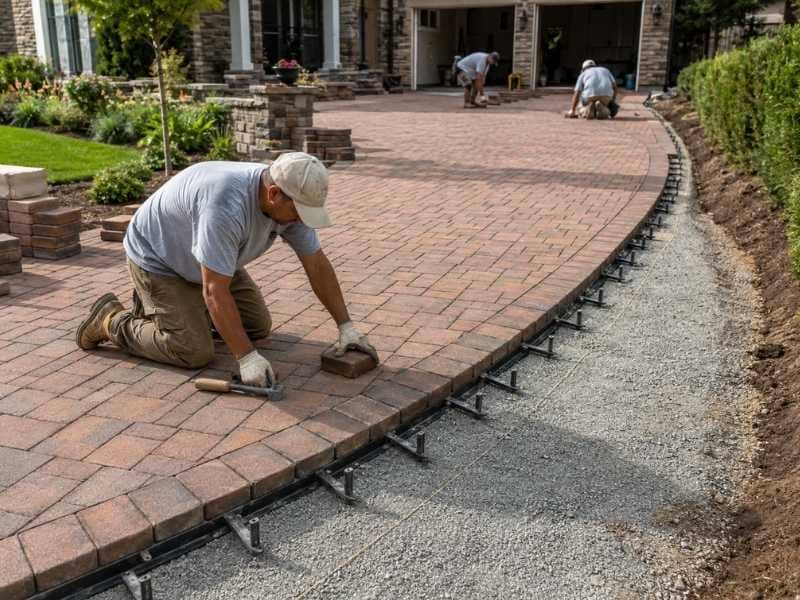
A driveway takes more punishment than almost any other paved surface at a home. Brick pavers can handle that load for decades, but only when the edges get locked down before any weight rolls across them. Vehicles push pavers sideways every time a tire turns or stops. Without a firm edge holding the field together, that push slowly spreads the pavers apart until gaps and ruts show up. The work that goes into the border decides whether the middle stays tight for years or starts drifting after the first season.
Read Where the Tires Push Hardest
Not every part of a driveway feels the same force. Turning tires grind against the surface with a twisting motion that flat driving never creates. Braking near the garage sends weight forward into the same few rows again and again. Curves, the apron where the driveway meets the street, and the garage entrance all take extra strain.
These high-stress spots should guide how the base and the edges get built. A section that only sees straight, slow travel needs less reinforcement than a tight turn or a steep entry. Planning around the hardest-working zones puts the strongest support exactly where the driveway will try to fail first.
Treating the whole surface as equal wastes effort in calm areas and leaves the busy ones short. A mason who studies how cars actually move across the driveway can match the prep to the real pattern of wear. That kind of reading turns a generic install into one built for the way this driveway gets used.
Build the Base Past the Edge of the Pavers
The prepared foundation under a driveway has to reach beyond the pavers you can see. Borders and perimeter restraints need solid ground under them too, not soft fill that gives way. When the base stops right at the last visible paver, the outer row has nothing firm to lean on.
That unsupported strip becomes a weak seam. The center of the driveway can look flawless while the edges sink, tilt, or creep outward under repeated traffic. Once the border starts to move, the failure works its way inward toward the pavers that seemed fine.
Extending the compacted base under the full paved area, edges included, keeps the whole system sitting on stable ground. A base that runs a bit wider than the pavers gives the restraint something real to grip. That extra reach costs little during the dig and saves a major repair down the road.
Anchor the Perimeter Against Sideways Movement
Edge restraint exists to fight one specific thing, the horizontal shove a tire creates when it turns or halts. Without that anchor, pavers drift outward a fraction at a time until gaps open across the field. The restraint holds the outer pieces in line so the rest stay packed together.
Several details decide whether that restraint actually holds. The type of restraint matters, along with how deep it sits and how it connects to the ground. Curves and the driveway opening need extra attention, since those are the exact places where sideways force peaks. Spikes or anchors set too shallow pull loose over time and let the edge wander.
A restraint that’s secured well around the tricky spots keeps the perimeter honest for years. The connection between the restraint and the base is where many jobs quietly fail. Done right, the edge and the field act as one piece and share the load a driveway throws at them.
Fill the Joints So the Pavers Act as One
Joint sand does more than fill the gaps between bricks. When the paver joints are packed full, the pavers lock against each other and share load like a single surface. That shared strength is what lets a driveway carry a car without any one brick taking the full hit.
Trouble starts when the joints sit half empty. Incomplete filling, sand that washes out early, or traffic that rolls on before the joints are set can all break the connection. Once that happens, individual pavers rotate, separate, or slide under the weight of a tire, and the smooth surface starts to feel loose.
Filling every joint completely, then keeping vehicles off until the surface is ready, protects the interlock that makes the whole driveway work. Full joints also help keep water and grit from working down into the base. A tight, connected surface simply holds up better against everything a driveway faces.
Plan Sections You Can Lift for Future Repairs
Someday part of a driveway will need to come up. A utility line might need service, drainage might need a fix, or a settled spot might need to be reset. Installers who think ahead leave those areas easy to reopen instead of building one solid slab of interlocked brick.
Smart planning keeps a few habits in play. The paver pattern gets documented so a repair crew can put it back the same way. A handful of matching units get stored for later, since dye lots change and an exact match gets harder to find over time. Repair boundaries get chosen at natural break points, so a small section can lift out without disturbing large runs of the driveway. That foresight turns a future repair into a neat patch rather than a full tear-out that never quite matches again.
Frequently Asked Questions
Where does a brick paver driveway experience the most movement?
The heaviest movement shows up wherever tires twist or stop. Sharp turns, the garage approach, curved runs, and the apron at the street all take strong sideways force. Those areas shift first when the edges aren’t locked down, so they deserve the most support during the build.
Should edge restraint continue across a driveway entrance?
Yes. The entrance is one of the highest-stress points on the whole driveway, since tires cross it constantly and often turn there. Stopping the restraint short of the opening leaves the busiest edge free to spread. The anchor should carry through that transition, not quit before it.
How is driveway edge restraint secured around curved sections?
Curves need closer anchoring and careful placement, because the outward push builds up along the bend. Restraint on a curve usually calls for more frequent anchor points set at the right depth, plus tight connections that follow the shape of the arc. Loose or widely spaced anchors let the curve drift outward under traffic.
Why must the joints be completely filled before vehicles use the driveway?
Full joints are what tie the pavers into one connected surface. Until the sand fills every gap, each brick sits more or less on its own and can rock or slide under a tire. Driving on partly filled joints lets pavers shift out of place before the surface ever settles.
How soon can a vehicle drive over newly installed brick pavers?
That depends on the joint material and the install method, so the installer sets the timing. The core rule stays the same, wait until the joints are filled and set. Rolling weight onto fresh pavers too early can loosen the edges and knock the surface out of line before it stabilizes.
