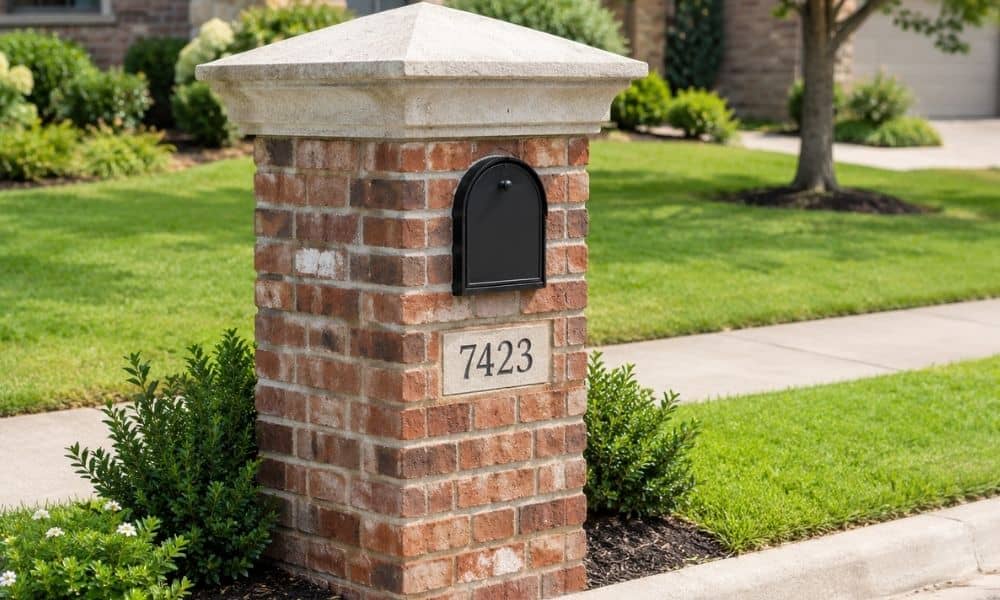
A stone mailbox sits out at the curb with nothing over it. No roof, no porch, no tree branch to block the rain. When a storm rolls through Fort Worth, the top of that mailbox takes the hit first, and water always looks for a way in from the top down. The cap stone up top is what stands between a hard rain and the parts you actually care about, like your mail and the metal box inside.
Most people never look at the top of their mailbox. They check the door, grab the mail and walk back inside. But the cap does quiet work every single day, and when it fails, the damage starts up high and moves down where you can’t see it.
The good news is that stopping this kind of damage is simple once you know where the water goes and what the cap is supposed to do about it. A weak or missing cap lets rain travel somewhere it shouldn’t. A good one keeps it off your mail and out of your stone.
Why the Top of a Stone Mailbox Takes the Worst Hits
The top of a stone mailbox is the most exposed part of the whole structure. It’s flat or close to flat, it faces straight up at the sky, and it has no cover at all. Rain, hail and wind-driven water all land there before they land anywhere else.
Fort Worth makes this harder than it sounds. Spring storms from about April through June bring heavy downpours and hail, and the wind pushes rain sideways so it hits the top and the seams at the same time. A mailbox at a storm-exposed entrance can get more weather in one afternoon than a wall tucked under your roofline gets in a month.
Stone and mortar also soak up water. Masonry is full of tiny holes, so a wet top doesn’t just dry off on its own. It pulls water inward, and gravity carries that water down into the column instead of letting it run off the sides.
How Water Moves Down Through the Column
Water that gets past the top doesn’t stay put. It runs straight down the inside of the mailbox, and it takes the easiest path down. That path leads right to the parts that cost you money and headaches.
Most stone mailboxes wrap around a metal mailbox. When top-down water reaches that metal box, it starts to rust. Rust spreads, stains the stone, and can leave the little door stuck or hard to close. Your mail sits in that same space, so damp or spotted letters are often the first thing people notice.
The water keeps going after that. It settles into the mortar joints lower down, pools at the base and soaks the bottom stones. Over a few seasons, joints that stay wet start to crumble, and in winter that trapped water can freeze. Water swells about 9 percent when it freezes, and that small push is enough to crack mortar and pop the face off a stone.
What a Good Cap Does to Keep Water Out
A good cap does one main job. It covers the whole top of the mailbox and sends rain off to the sides before it can soak in or drip down inside. Think of it as the roof for the little structure.
The cap should sit a bit wider than the column so its edges hang past the stone below. That small lip, called a drip edge, lets water fall clear of the face instead of running back against it. A cap with a gentle slope, even just a few degrees, moves water off faster than a dead-flat top that lets rain pool and sit.
The seam under the cap matters as much as the cap itself. That’s where the cap meets the top course of stone, and it’s a common spot for water to sneak in. A mason beds the cap in fresh mortar and seals that joint so rain rolls off the edge instead of slipping under it and heading for the mail.
Signs Water Is Already Getting In From Above
You can catch most cap problems early if you know what to look for. The clues show up around the top and the mail door, not just at the base. Walk out after the next big storm and check for these:
- Rust streaks or brown stains running down from the mail door
- A mail door that sticks, drags or won’t shut all the way
- Damp, curled or spotted mail even when it hasn’t rained in a day or two
- White, chalky stains trailing down from the cap seam
- A cap that feels loose, wobbles or has shifted off center
- Crumbling or missing mortar in the joint right under the cap
Any one of these means water is finding a way in from the top. Two or more together means the cap has likely been leaking for a while, and the fix only gets bigger the longer it waits.
Getting the Cap Fixed Before It Costs More
The cap is a small part, so fixing it early is one of the cheaper masonry repairs you can make. A mason can re-bed a loose cap, reseal the seam or set a proper cap with an overhang if yours is flat, undersized or missing. That work usually takes far less time and money than rebuilding a column that’s been soaking for years.
If your mailbox already shows rust stains, a stuck door or soft mortar near the base, the water has done more than surface damage. At that point a mason should check how far it has traveled before sealing anything back up, since trapping wet stone only makes it worse. A quick look after storm season is the easiest way to stay ahead of it.
Your stone mailbox handles more weather than almost anything else on your property, and it does it with no roof and no overhang to help. The cap is the one part carrying that load. Keep it tight and sloped, and it will keep water where it belongs, which is off your mail and out of your stone.
Frequently Asked Questions
What is a stone mailbox cap?
The cap is the top stone that covers a stone mailbox and works like its roof. It closes off the open top of the column and pushes rain to the sides so water can’t drip straight down inside. A cap that hangs a little past the edges works best, because it carries runoff clear of the stone face.
How can I tell if water is getting into my mailbox from the top?
Look near the mail door and the top of the column, not just the ground. Rust streaks below the door, a door that sticks or letters that feel damp all point to water coming in from above. Chalky white marks below the cap seam are another common clue that rain is slipping under the cap.
Can I seal a stone mailbox cap myself?
You can brush a breathable masonry sealer on the surface, and that helps a dry, sound cap shed water. But a loose cap, a cracked seam or a cap with no overhang needs a mason to re-bed and reseal it the right way. Sealing over a cap that’s already leaking traps the water and speeds up the damage.
Does every stone mailbox need a cap?
Yes, because the open top of a stone column is the easiest place for water to get in. Without a cap, rain lands on bare stone and open joints and soaks straight down toward the mail and the base. A well-fitted cap with a slight slope and an overhang is the simplest way to protect the whole structure.
How often should I check my mailbox cap?
Check it at least once or twice a year, and again after any big storm or hail. Fort Worth’s spring storm months are a smart time for a close look, since that’s when wind-driven rain hits hardest. A two-minute check for a loose cap or fresh stains can save you a much larger repair later.
