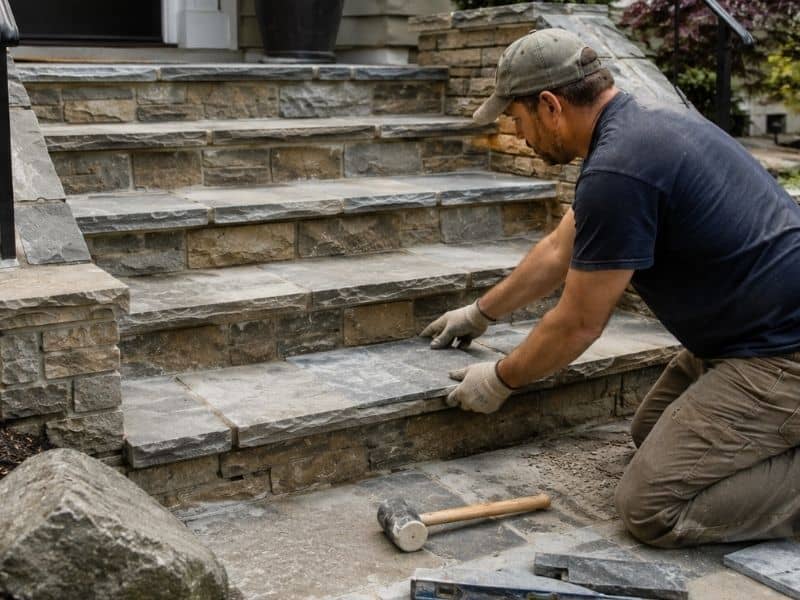
Walk up to enough front doors and you will notice something. Some stone steps feel easy, almost like your feet already know where to land. Others feel a little off, too tall in one spot or too shallow in another. A construction survey of an entrance rarely stops at “how many steps do we need.” A stone mason looks at the slope, the stone itself and how a person’s foot actually moves across it. Getting that right is the difference between steps that feel natural and steps people quietly avoid using at night.
How Stone Steps Can Match the Slope of a Residential Entrance
Every sloped entrance has its own personality. Some rise gently over a long stretch of yard. Others climb fast in just a few feet. Before placing a single stone, a mason measures the total rise (the full height from the ground to the door) and the total run (the horizontal distance the steps will cover).
That measurement shapes everything else. A steep, short slope might call for narrower steps stacked closer together. A long, gentle slope gives more room to spread steps out, which can make the climb feel almost effortless. Skipping this step, and just guessing at spacing, is exactly how you end up with an awkward stair that trips people up on the way to the porch. The slope decides the plan. The plan does not get forced onto the slope.
Choosing Step Dimensions for a More Comfortable Stride
Once the rise and run are set, the real work starts: figuring out how tall and how deep each step should be. This part matters more than most homeowners expect. A step that is too tall forces a person to lift their leg higher than feels natural. A step that is too shallow does not give enough room for a full foot, so the front of the shoe hangs off the edge.
Consistency ties it all together. If one step is six inches tall and the next is seven and a half, your body notices, even if your eyes do not catch it. That small mismatch is often what causes someone to stumble on a stairway they have climbed a hundred times before. A good mason keeps every step in a flight close to the same height and depth, so your legs fall into a rhythm and stop thinking about it. That rhythm is really the whole goal. Once your feet stop guessing, the stairs disappear and the walk feels effortless.
Stone Surface Choices That Improve Everyday Footing
Not all stone feels the same under a shoe. A smooth, polished surface might look sharp in a photo, but it can turn slick fast once dew settles on it in the early morning. A rougher, more textured stone grips better, especially on the leading edge of each step where most of your weight lands.
Shape plays a role too. Stones with slightly uneven or natural edges can actually help, since they break up the surface and give your foot more to grab onto than a perfectly flat slab. This is not about picking the fanciest stone available. It is about picking one that behaves well every single day, in dry heat, in light rain and in whatever a North Texas front happens to bring that week.
Building Transitions Between Stone Steps and the Entry Walk
Steps rarely stand alone. They connect to a walkway on one end and a porch or landing on the other, and those connection points are where a lot of stairways start to feel clumsy. If the bottom step sits too far above the walkway, or the top step lands unevenly against the porch, the whole approach feels disjointed even if each individual step was measured well.
A mason handles this by treating the entrance as one continuous path rather than a stack of separate stones. Grade changes near the bottom and top of the stairway get eased in gradually instead of dropped in all at once. Done right, you should not even notice where the walkway ends and the steps begin. Your stride just carries you through.
Step Details That Make Sloped Entrances Easier to Use
A handful of smaller details end up mattering more than people expect once the steps are actually in daily use.
- Step edges: A slightly rounded or chamfered front edge is easier on bare feet and less likely to chip over time than a sharp, square corner.
- Landings: On a longer or steeper flight, a landing gives people a place to pause partway up, rather than powering through one long, tiring climb.
- Drainage: Water needs somewhere to go. Steps built without a plan for runoff can pool water on the tread, which turns into a slip risk the moment temperatures drop.
- Spacing: Steps set too close together crowd a natural stride, while steps spread too far apart force an awkward reach with every stride.
None of these details replace solid rise and run planning. They finish the job and make an already well built stairway genuinely pleasant to use every day.
Frequently Asked Questions
What makes stone steps comfortable to walk on?
Consistent step dimensions, a suitable surface texture, stable placement and smooth transitions all work together to make stone steps feel natural underfoot.
How does a stone mason build steps on a sloped entrance?
A mason looks at the existing grade, works out the needed rise and run and then plans the sequence of steps and landings to fit that slope.
What type of stone is best for residential steps?
The right choice depends on the look you want, how much traction the surface offers, how durable the stone is and the conditions around your entrance.
Do stone steps need landings?
Landings are useful on longer or steeper entrances. They give people a spot to pause and break up what would otherwise be one long, continuous climb.
How can stone steps provide better footing in wet weather?
The right surface texture, a solid drainage plan and careful installation all help cut down on slippery conditions around a residential entrance.
