
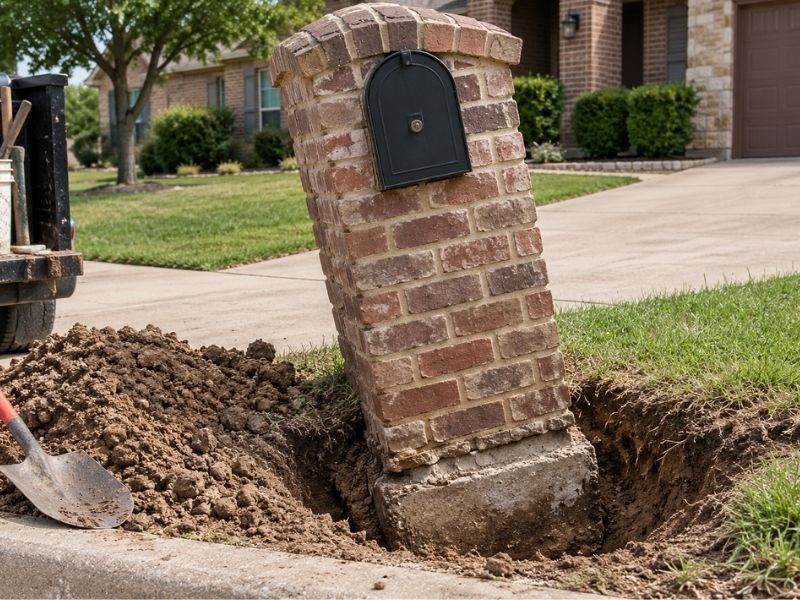
A brick or stone mailbox that tilts to one side rarely fixes itself, and mailbox repair that only touches the surface won’t hold. The column looks solid, but the real trouble usually sits underground where you can’t see it. When the footing below the bricks shifts, the whole column leans with it. Fresh mortar on top hides the tilt for a while, then it comes back. Real repair starts below grade, where the problem began.
Why a Leaning Masonry Mailbox Usually Points to a Foundation Problem
A masonry mailbox leans when the footing under it moves, not because the bricks themselves failed. A brick or stone mailbox looks heavy and solid, but it stands on a small concrete footing buried in the soil. That footing carries the weight and keeps the column straight. When the ground under it settles, washes out or swells, the footing tips and the bricks follow. So a lean is a signal from below. Straightening the top without fixing the footing just sets up the same lean again.
A Below-Grade Inspection Reveals Damage Hidden From View
A good inspection digs below the surface to find why the footing moved. You can’t judge a footing by staring at the brickwork. A mason has to expose the base and check the soil and concrete underneath. Common findings include:
- Settled or washed-out soil that left the footing with no support
- A cracked or crumbling concrete footing
- A footing that was too small or too shallow from the start
- Erosion from poor drainage or runoff near the column
Once the mason sees the real cause, the repair plan makes sense. Guessing without a look rarely holds a mailbox upright.
Why Repointing and Surface Patching Can’t Correct Structural Movement
Fresh mortar and patched cracks improve looks but add no support to a footing that has shifted. Repointing means raking out old mortar joints and packing in new ones. It’s fine work for tired joints, but it does nothing for a base that moved. Patching a crack works the same way. The crack fills in, yet the column still leans because the ground under it never changed. So the tilt comes back, often within a season or two, and you pay twice.
Repair Options Based on the Condition of the Footing
The right repair depends on how much of the footing a mason can save. Not every leaning mailbox needs a full teardown. When the footing is mostly sound, a mason can reinforce it, improve the soil around it and reset the column straight. When part of the base has failed, a partial rebuild replaces the bad section and keeps the good one. When the footing is cracked through or far too small, a full replacement is the honest answer. In many cases the original brick can come off carefully and go back on, which saves money and keeps the mailbox matching the house.
Fort Worth Soil Conditions Make Early Mailbox Repair More Important
Fort Worth’s clay soil moves with the weather, so a small lean can grow fast if you wait. North Texas sits on expansive clay, some of the most active soil in the country. It swells when spring rain soaks in and shrinks when summer heat dries it out. In much of Tarrant County, most home lots sit on this high-shrink clay. Fort Worth also gets about 37 inches of rain a year, and those wet springs and dry spells push the soil through a steady swell and shrink cycle. A small mailbox footing sits right in that moving top layer, so it feels every change. Catch a slight lean early and the fix is usually simple.
Frequently Asked Questions
Can a leaning brick mailbox be repaired without rebuilding it?
Often yes. If the footing is still mostly solid, a mason can reinforce the base, correct the soil around it and reset the column straight. A full rebuild is only needed when the footing has cracked through or was built too small.
Why doesn’t a new mortar stop a masonry mailbox from leaning?
The new mortar only refreshes the joints between bricks. It adds no strength to the footing buried below. If the base has shifted, the column keeps leaning no matter how clean the joints look. The movement has to be fixed at the footing.
How can a mason determine if the mailbox footing has failed?
A mason exposes the base and checks the soil and concrete beneath the bricks. Settled soil, a cracked footing, erosion or a shallow footing all point to failure. The brickwork above can’t show these problems, so the ground gets checked directly.
What causes masonry mailbox foundations to shift in Fort Worth?
Expansive clay soil is the main cause. It swells with moisture and shrinks in dry weather, which lifts and drops small footings over the seasons. Poor drainage, runoff and shallow original footings make the movement worse.
Is it possible to reuse the original brick during mailbox repair?
Usually yes. A mason can take the column apart with care, clean the old brick or stone and set it back once the footing is stable. Reusing the material keeps the mailbox matching your home and lowers the cost.
